I consume a lot of AI content, and I also bookmark a ton of information on X that I want to come back to later. The key word there is want. In reality, I rarely look at a bookmark again.
I am working on a Codex automation to synthesize all of that bookmarked content, but it is not done yet, mainly because I am still working through how to make it useful. For now I do all of this pretty informally, and if I see something interesting I figure out whether the person seems credible before I spend more time on it or try it myself.
How I decide who is worth listening to
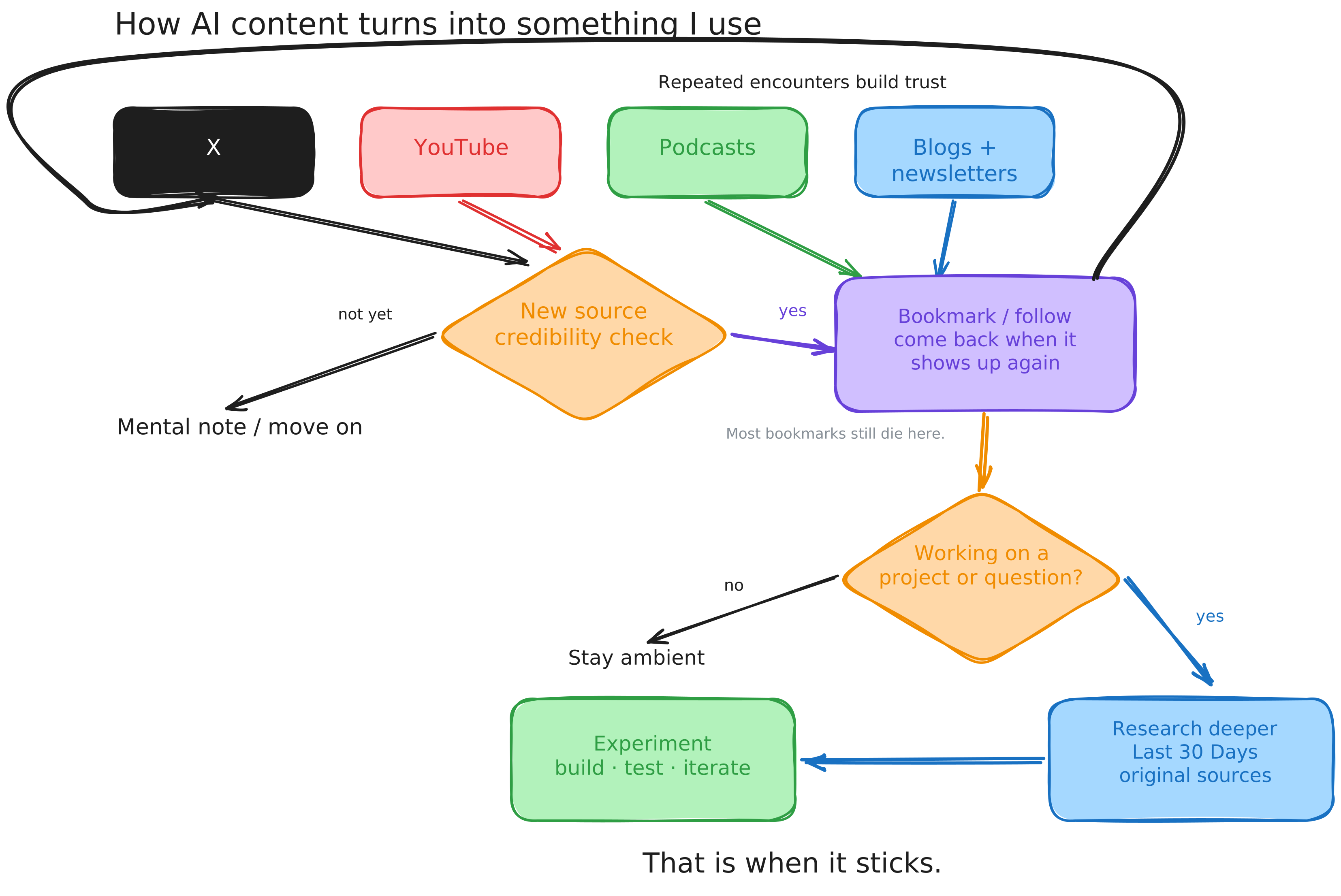
A lot of things can pique my interest on X. Is it some tool or flow I am interested in, was it reposted by someone I find credible, or does it have a lot of engagement? If any of those are true, I look, but none of them mean the post is right.
When the account is new to me, I see who they follow and scan through their content. It becomes pretty easy to tell if the content is original or if they are just regurgitating slop, especially once you have looked through more than the one post that showed up in your feed. Are they building something, and do they have actual work behind what they are saying?
A lot of times I do nothing after that except make a mental note that, if I see the account again, it seemed credible. If over time I keep engaging with the person's content, then I may follow them, but I don't need to follow everyone the first time I see something useful.
That is how I start developing a tree of credible people. Most credible people follow other credible people, so I look at who they follow and eventually one person leads me to another. Obviously that does not mean everyone in the tree is always right. It is just a better place for me to start than treating every account in the feed the same.
Over time, my interests change, and I end up changing who I follow pretty significantly. My timeline used to be almost exclusively sports. Now AI, startups, and investing are mixed in too.
Theo Browne and T3 Code are a good example. He puts out a ton of content, and it is clear he is a super developer because he actually builds things. He is also critical of the AI labs when he thinks they deserve it, which makes the content feel more authentic to me than an account that says every release is amazing.
The most recent rabbit hole for me has been Buzz from Jack Dorsey. I saw people talking about it and also watched Greg Isenberg cover it, and I am still going down that rabbit hole now. Buzz is an open-source desktop app where people and AI agents work together in communities and channels. I don't know yet if I will build anything with it or where it will go, but it has piqued my interest as well as the interest of other early movers I follow in AI.
Greg's content is also how I found Ras Mic, or Michael Shimeles, who covers software development, programming tutorials, frameworks, and developer productivity. That is a pretty normal discovery path for me: someone I already spend time with introduces me to another person, and then I go look for myself.
What I use each one for
I spend most of my time on X, where I have curated the For You tab to feed me a lot of AI content. Some is garbage slop but a lot of it is good, and it ranges from the market perspective to how people are actually building with AI and using it every day.
I use YouTube to teach myself how to do new things in AI, whether that is different software to use, how to build software, how to set up skills, or what models to use. I am constantly learning and experimenting, and things really set in with me once I use them myself. YouTube is also another place where I discover people through guests on shows, channels I watch regularly, or something it suggests.
Podcasts are usually a deeper dive on the business side of AI for me, including exposure to markets, new companies, and what may happen next. I am always curious about the second- and third-order effects of AI growth, especially because I work in energy and live some of those changes every day.
I also learn from blogs and newsletters. I subscribe when the subject interests me, when I think I might learn something, or when I already follow the author somewhere else. My twice-weekly briefing covers newsletters such as Every, Stratechery, Not Boring, and Late Checkout, and it helps me figure out which original articles I want to go back and read. It does not do the reading for me, but it gives me a better shot at coming back to the good stuff.
A project changes the question
If I am working on a project, or I want to research something more deeply, I stop browsing so broadly and start looking for what I need. The question gets more specific because I have something I am actually trying to accomplish.
That is usually when I use Last 30 Days. I use it when I want to deep dive a topic, and it pulls recent information from social and web sources. I still look at where everything came from because what it pulls depends on how the skill is set up.
After that, I try things myself because that is when they really set in with me and when I see what I still don't understand.
It is hard to pick one piece of content that changed how I work, but I have really leaned into using the Codex app after watching Dan Shipper and Every go through it and seeing a lot of other Codex content on X. Every also published a conversation between Dan Shipper and Austin Tedesco about moving from Claude Code to Codex for knowledge work.
Before that I was using ChatGPT for standard chat and Claude Code more as my coding agent, but through the terminal. I am not a native developer, so the terminal was a foreign concept to me. I figured it out, but it was not innate and it took me longer to adapt.
The experience inside Codex fits me better. I like the projects and thread organization, but the bigger thing is having the browser, files, agent views, terminal, and other options together in the right panel where I can see and use them. Anything where I am running one of my apps in the browser with the agent next to it feels better to me.
I am also a big user of scheduled automations. I actually got that idea from Anthropic because they had it first, but when Codex offered it I liked the UI and feel better and started using it there. All the scheduled integrations feel better to me inside the app.
What I want the bookmark agent to do
I bookmark a ton of information on X that I want to come back to later, and I rarely come back. I am working on a Codex automation to synthesize my bookmarked content, but it is still a work in progress.
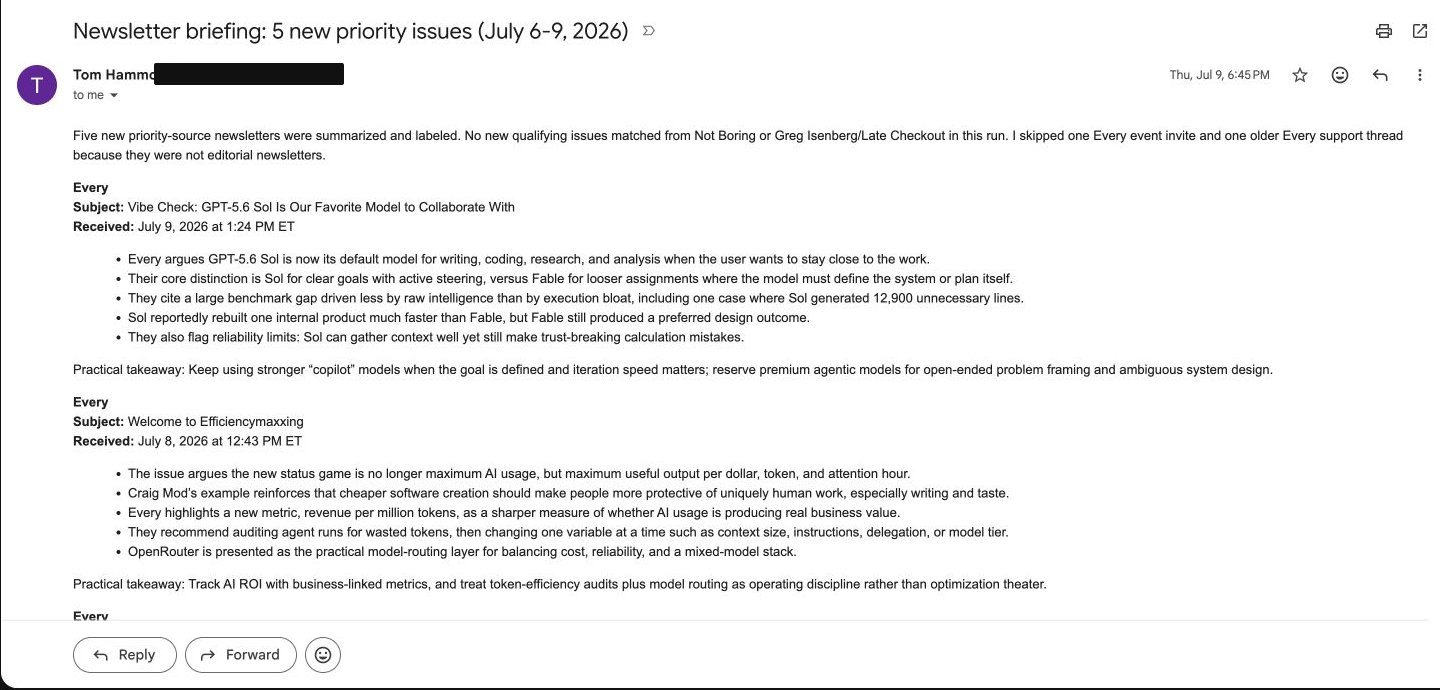
I already have a version of this for newsletters. Twice a week, I get a short briefing with the main ideas from newsletters such as Every, Stratechery, Not Boring, and Late Checkout, and then I choose what is worth my time. It helps me get back to the original articles, but it does not read them for me.
That is what I want the X version to do. Show me what I kept saving, where the same ideas keep coming up, and which few posts may be worth opening again. I also want to automate when useful things from my bookmarks should be used in whatever I am working on in Codex, whether that is a software project, a scheduled automation, a new skill, or research. I want Codex to be able to pull from the information I found on X and apply it. I still have a lot of work to do on this, but stay tuned.
I am still going down the Buzz rabbit hole, and the bookmark automation is the next thing I want to make useful.
Disclosure: This post was written with help from Codex and grounded in Tom's firsthand experience and public sources.