I subscribe to newsletters because I either find them interesting, I am trying to learn something new, or I am a fan of the author. The problem is that they arrive while I am doing something else. I miss the email in my inbox and rarely get back to reading them. I was not checking every newsletter site to catch up either.
I built this automation to put those newsletters back in front of me twice a week. It does not make me read them, but it removes the excuse that I missed the email.
One briefing led me to Sarah Guo
One recent briefing included Colossus's "Sarah's Wager," a profile of investor Sarah Guo by Dom Cooke.
I really enjoy those profiles. In this case, the briefing caught the Sarah Guo piece and I listened to Colossus's narrated version on my commute home.
I was impressed by how much she has accomplished so early in her career. It was a reminder of the level of relentless agency that some people have, which leads to continued success. I try to use this as motivation for myself.
That is what I want this briefing to do. The summary should help me decide what deserves more time, then get me into the full article or audio. I want to understand how really smart and successful people think about the world.
What happens during a run
Twice a week, the scheduled task searches Gmail for new messages from the newsletter senders I follow. It skips spam, trash, and anything already marked as summarized.
A sender match is not enough because newsletter companies also send event invites, login messages, promotions, and support emails. Codex opens the email candidates and keeps only the actual newsletter issues.
Then it reads the qualifying issues together. If Gmail clips a long one, Codex opens that message again by itself to make sure it captures all the necessary context of the article. The email briefing includes the sender, subject, date, three to five ideas, and practical takeaways from each issue.
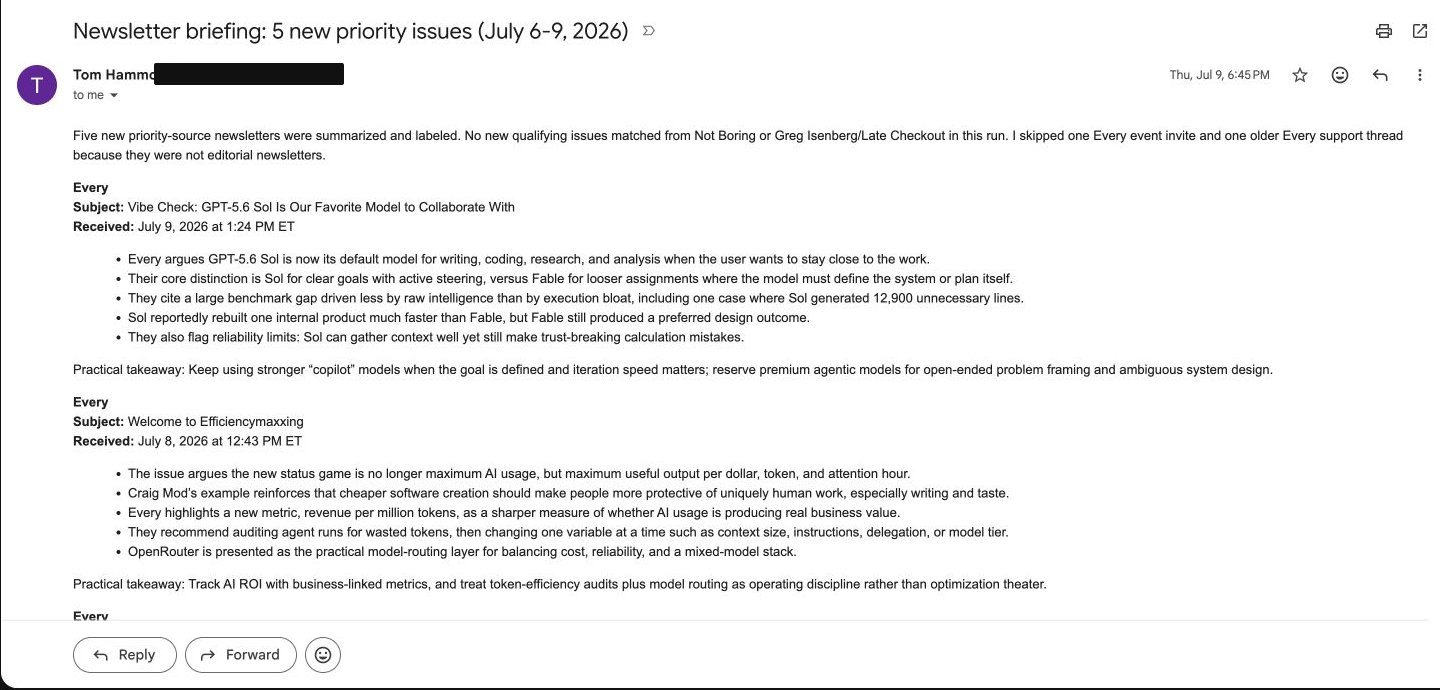
After the briefing is sent, Codex applies two labels to the newsletter emails. The purpose of the labels is to make the included emails easy to find and also prevent the next run from summarizing them again. I also get a short Codex receipt telling me the run finished and how many issues it covered.
What I changed after the first run
I capped the first run at seven days because I did not want years of unread email turning into one giant backfill. It found eight real newsletter emails within those seven days.
However, the Gmail search found more than eight total messages because the same senders also send other promotional emails. That is why Codex opens every candidate and reads it before deciding whether it belongs in the briefing.
The first six successful runs covered 31 real, new issues. That was enough for me to trust the filtering and stop trying to remember every sender on my own.
The summaries will not always emphasize the same thing I would. The Sarah Guo profile is the outcome I care about: the briefing caught my attention, and I went and listened to the whole thing.
I also regularly read Every, Stratechery, Not Boring, and Greg Isenberg's Late Checkout. They give me different ways to think about businesses, industries, investing, and the people building them.
Where I want to take it
This is already much better than subscribing and forgetting. Twice a week, I get a short list and choose what is worth my time.
The remaining friction is that the briefing still arrives by email. I want the next version to send the full briefing and links by text so there is one less place for it to disappear.
In an ideal world, Codex would also narrate the briefing and put it in my own private RSS feed. I prefer to listen to a lot of content on my commute or while I am working out. I could play the briefing like a podcast, then open the original when something caught my attention.
Written with help from Codex, based on my firsthand experience and notes.